County Fairby Eric Sundquist High/Coo Chapbook Award 2026 ISBN 978-1-929820-42-9 • perfectbound ~ ~ ~ For millennia, cultures around the world have held festivals to mark celestial cycles, propitiate various gods, celebrate rites of passage, and bless the seasons of planting and harvest. The several thousand county and state fairs that occur annually in the United States have a good deal in common with these ancient rituals, which were often marked, as James Frazier writes in his classic study, The Golden Bough (1922), by a “period of license . . . when the whole population give themselves up to extravagant mirth and jollity.” American fairs also have a more recent EuroChristian origin. Just as the word fair derives from the Latin feriae, “holy days,” so carnival comes from carne levare, loosely a “farewell to flesh,” the days of indulgence culminating in Mardi Gras before the onset of the abstenious days of Lent. Whereas the spring festivals of Easter (a moveable feast) and May Day (situated midway between the equinox and the solstice) celebrate rebirth and new growth, in European and later American agrarian traditions fairs held during harvest season rose to prominence. Why haiku about county fairs? In most haiku sparked by holidays and festivals the distinctive “moment” or “slice-of-life” aspect of the form is vivid—a small human drama, usually with a distinctive seasonal element, captured in a few carefully arranged words. In traditional Japanese haiku, prominent examples of such seasonal celebrations would include the New Year (lunar or, in the modern era, solar), Cherry Blossoms (spring), and Harvest Moon (autumn). Like similar holidays, festivals, and fairs worldwide, these occasions usually feature costumes, fireworks, musical and dramatic performance, and special food. Although the focus on human and communal activity means that such poems often have the comic spirit of senryu, it might also be said that any group of poems set during a seasonal celebration of harvest is by definition a haiku sequence. ~Eric Sundquist |
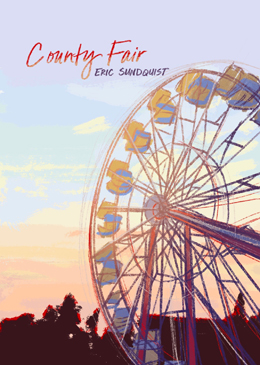
ISBN 978-1-929820-42-9 ~ ~ ~ ORDER Directly from Brooks Books Brooks Books Special Discount for Web Site Orders! If you order a copy of COUNTY FAIR directly from this Brooks Books web site, you receive a 20% discount. Therefore your cost is $12.00 plus $5.00 for shipping and handling. Order your PRINT copy through this Paypal link: View Shopping Cart: |
|
PDF Edition (no postage costs) Due to the expense of shipping books to international addresses (or for those who prefer a PDF copy), Brooks Books is pleased to offer a PDF edition of COUNTY FAIR. The price for the PDF edition is the same as the print edition, but this saves customers the postage cost. ORDER the PDF edition from Brooks Books For those who want to purchase the PDF edition, please use the following PAYPAL button for this PDF EDITION order: |
Acknowledgments A short sequence of these poems, including “midway promenade,” “merry-go-round,” I am grateful to Paul Miller for his editorial guidance on that occasion. Some of the historical background on county fairs in my introduction is drawn from John McCarry, County Fairs: Where America Meets (1997). Thanks most of all to Randy and Shirley Brooks for bringing this little book into print and for their long dedication to the art of haiku. ~Eric Sundquist |
About the Author Eric Sundquist was born in 1952 and raised in the small central Kansas town of McPherson. Educated at the University of Kansas and Johns Hopkins University, he spent four decades teaching American literature at a number of universities. His scholarly work, devoted to a wide range of nineteenth and twentieth-century authors, received several prominent awards. Growing up when and where he did, he considers himself fortunate three times over with respect to fairs. Each spring, his hometown hosted a May Day weekend, which included a May Fete, a parade celebrating graduates of the county’s schools, and a three-day carnival. In late summer came the county fair, a comparatively smaller event featuring rides, agricultural displays and prizes, and local food and entertainment. In the early fall the far larger state fair, just a half-hour drive away, offered a more spectacular carnival and Midway, the best of the state’s livestock and produce, stock car races, and musical stars both current and yesteryear. |
2026 Subscription PDF Bundle2026 HIGH/COO Chapbooks International subcribers and/or those who prefer digital copies will receive PDF editions of the four 2026 winning chapbooks instead of print editions. There is no postage charge for this PDF subscription, so annual subscription is $30 USD payable with PayPal:
|
2026 Subscription Print Bundle2026 HIGH/COO Chapbooks USA subcribers may purchase a High/Coo Chapbooks Subscription for all three print-edition chapbooks for $30, plus $5 postage and handling. There is a $5 postage charge for this print copy subscription. You may purchase your chapbooks bundle as a secure transaction through PayPal:
|